
By Jeffery K. Liker
Book Review

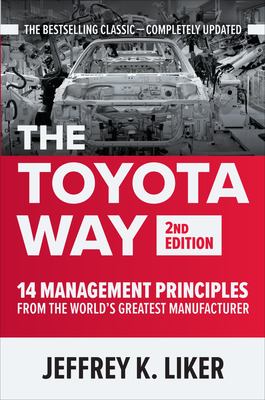
This was not a book I would typically read. Why do I want to know about the vehicle brand Toyota? I’m a writer, not an automobile manufacturer. The book came as a recommendation from a colleague at work. He has a side business and got this book for his birthday. The Toyota Way wasn’t about the vehicles. It was about how the corporation Toyota approaches efficiency within all their businesses (they don’t just make vehicles but also prefabricated high-rise homes) and the relationship with workers for the betterment of the company. Toyota even goes to competing auto companies to teach the Toyota Way!
That piqued my interest. Why would a business give the competitor an edge to beat them out? It’s explained in the book.
I recommend reading a chapter a day. The book can be dry, but it also has many concepts new to North American audiences if they have no influence with Asian culture. The big takeaways for me were the idea of the relationship with employees to production to managers, the business philosophy of the company, and retraining staff instead of layoffs and termination.
I remember watching Ford vs Ferrari. One of the scenes which I think exemplifies North American business egos (I used to work in engineering and for municipalities) is when the president of Ford goes on the floor and blames the workers who are assembling the cars as the reason the company isn’t selling cars, while the president is the best the company had to offer. A reasonable person with common sense could see the sales of vehicles have nothing to do with the person assembling them unless there were errors in manufacturing. Which in the context of the film, was not the case.
The Toyota Way recognizes that the workers on the floor have the unique experience of seeing how the part is assembled and having an idea of how to improve it. When asked how many engineers they had working on the cars, Toyota management would respond (I’m paraphrasing from memory), “We have two hundred people on the floor, those assembling the vehicles.” The last part depends on management giving the workers the opportunity to express themselves to improve Toyota’s product and how they view workers, not as assemblers but as part of the engineering team.
I worked in Fit4Less part-time. My manager was the best I ever had, as was her boss. This feedback came organically. We got a water sprayer to test. Instead of Corporate telling us where we had to use it, we were allowed to try it on the scenarios we thought would be helpful. When the testing was opened up to the team, other team members found different and effective ways the device could be used around the club for the efficiency of cleaning. With other issues like running out of the soap we use for cleaning the showers, we found it was an effective backup to clean. We wouldn’t have identified those areas if Corporate had demanded that we use the sprayer only to clean behind the toilets. There would be no incentive for pride of work to provide feedback.
Toyota has an altruistic (for lack of a better term) way of working in their communities, where there is profit. Instead of only sharing it with shareholders, they invest in their communities. There’s a reason there is a city in Japan called Toyota City. There is an idea of giving back to the community that serves you so that everyone can benefit in some way or another. This can go from helping cultivate better parks, helping the local community with new sidewalks, or fixing all the potholes with a mill and pave of the roadway top. When people’s and the community’s lives are better, the happiness and efficiency index grows, which means a better economy and better living.
Altruism did not ruin their profits! During the economic downturn in the 2000s, Toyota barely laid anyone off or fired them. Instead, they had unused workers trained to make more knowledgeable workers when production could go back to normal, keeping them occupied and drawing a salary. Toyota understood that the time invested into the worker was too valuable to let go. They didn’t keep employees because of a revolving door (a revolving door means employees come and go, so there is no reason for Corporate to improve working conditions because they will always have another hire). Plus, there was the respect for the worker and their livelihoods. During the downturn, Toyota still had more profits than the other auto companies combined.
The Toyota Way was fascinating to see how a company that has been around for nearly one hundred years was slow to advance, but that allowed them to sincerely think about the 1, 2, 5, and 10-year goals. The company’s philosophy has been passed down through directors and managers for generations, making the company as strong and profitable as it has been. This book is fascinating, and if one is business-minded or even has the idea of improving their community, this is something to read. It can also influence how one works at home or the improvements a person wants to bring to projects.

 Michael Leask
Leave a comment