The bottom line, I don’t think this is a good game. It’s playable and works in the 70+ hours it’ll take to beat the game, but that’s not a good selling feature.
With many flaws and failures with the mechanics, I enjoyed some things about Andromeda, not that it set itself apart from Mass Effect: Legendary Edition (the Trilogy). Instead of writing a boring detailed list, I will discuss the top three things that stood out to me.
Cora’s Loyalty Mission.
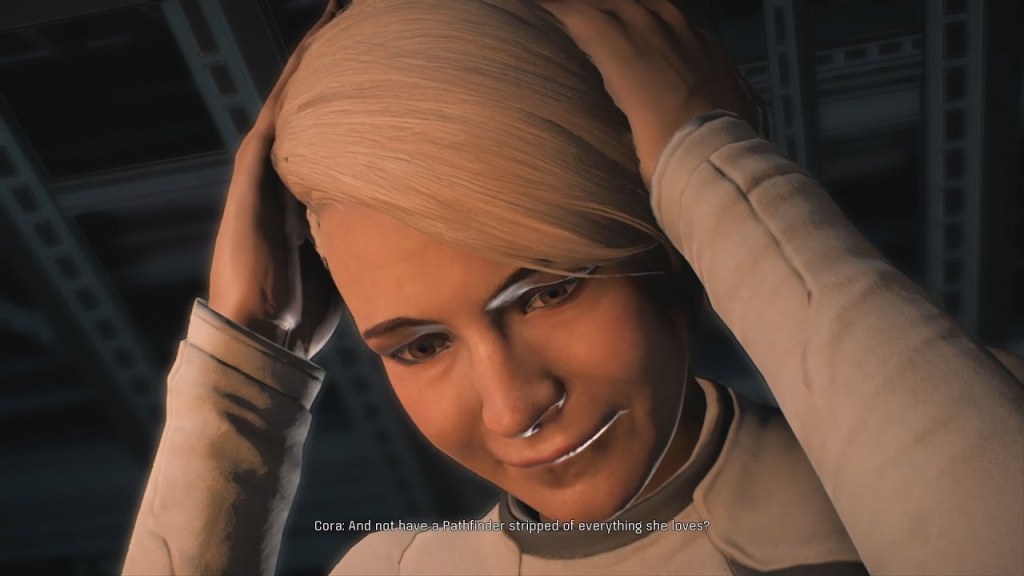
What if you got a chance to meet your idol? What if that idol betrayed everything they taught a huntress to do? Someone whose work pushes you through the trenches and motivates you to keep going? It could shake your foundation when the decision to remove the idol from a position of power falls on your shoulders. This is Cora’s loyalty mission. It is my favourite mission of the entire game because it’s deep and has serious consequences.
In Andromeda, Humans, Asari, Salarians, Turians and other species are on Arks that travel from the Milky Way galaxy to the Andromeda galaxy. Things don’t go according to plan and become ‘missing’. One of the primary goals in the game is to find them.
I wanted to find the missing Arks not for the story (see the negative review) but because of my empathic nature. Along this journey, the player dives into a great case in character development for a member of your team, romance option, and the general story.
Cora is set up to be the next Pathfinder after Alex Ryder, the chosen one to find the path for the initiative to go on. Circumstances out of her control, Alex sacrifices himself to save the life of his son/daughter (depending on who you choose), and this inexperienced child is now the pathfinder. She doesn’t argue with it or becomes a pseudo-pathfinder for the new Ryder to grow into the role. She accepts it. Boring character development.
Along comes Cora’s loyalty mission which defined who she was and who she aspired to be. Cora was sent to the Asari when she was old enough, joined their commando training, and became a huntress. From the game’s beginning, Cora always mentioned Sarrisa’s manuals, quoting them as much as she revered Sarrissa for making them. So what kind of story would she experience when she meets her idol?
Long story short, the Asari Pathfinder, Matriarch Ishara, was killed in a skirmish to retrieve navigation data through the scourge. Sarrisa became the next Pathfinder. When Ryder and crew find the Asari Ark, Cora is tickled pink to meet Sarrisa, further motivated to protect the Ark and return it to the Nexus.
So it was an interesting and engaging dilemma when the truth of the Matriarch’s death was revealed: Sarrisa left the Matriarch to die for the data. The data may be used to navigate the scourge if the captain of the Asari Ark isn’t competent in navigating through it.
It wasn’t that Sarrisa’s actions were necessarily wrong. She thought the data could save more lives. Where she was wrong was abandoning her Pathfinder for it, then lying about it. This signals Sarrisa knew her errors and tried to cover them up. Ultimately the choice is left to the player, continue to cover it up or reveal the truth. I chose the latter. Everyone deserves that transparency. What’s the point of going to the Andromeda Galaxy if the mistakes of the past are to be repeated? Where’s the fresh start?
Cora’s pissed, but more than that, her core identity is shaken. Can she be a Pathfinder, or will she always be in the shadow of someone great? She doesn’t realize that she is part of the team, part of the whole, and being part of the team casts a great shadow. She may be a Pathfinder one day, but she needs to learn more about how she sees herself. It was great storytelling in Andromeda. So much so that I played this level twice. I wished more missions in Andromeda were as powerful as Cora’s loyalty mission.
The feeling of loss.

Before I played Andromeda, I played the Trilogy back to back to remember the details of the story (and DLC I’ve never played before). I got used again to Garrus, Tali, Ashley and the crew of the ships that carried the Normandy name. I laughed at their antics; I was empathic to their needs and the needs of their cultures; I wanted to save as many people as I could; I cried at the end with Shephard’s choice and the memorial honouring those who died to save the galaxy.
When I pressed Start to play Andromeda, I forgot that this game takes place 600 years after Mass Effect 3 (though the Arks left in between Mass Effect 2 & 3, the time difference is negligible in the scale of travelling between galaxies). I was immediately hit with a sense of loss. I didn’t have closure with my favourite (and less favourite) characters. Did Tali build her house and exist without her suit? Did Ashley leave the military and settle down? What happened with the rest of the galaxy? Then it hit me. It’s irrelevant. A moment ago, they were here. Everyone I knew (that doesn’t live a thousand years) in the Milky Way is gone. Anything that shaped the galaxy is out of my control. Just like the people coming out of cryo, I was in shock.
I don’t know if the writers/game designers intended the sense of loss as an effect players would experience, or if they intended the game at face value: the IP is set in a new galaxy, and logically, it takes a long time to get there, the end.
It’s whatever I, as the player, make of it. The loss of that world back in the Milky Way motivated me in this game to want the Initiative to succeed in honour of the memory of the peoples of the Milky Way.
Yes, I know this is fiction, but I’m being empathetic.
Why am I discussing the sense of loss in this blog? From a writer’s perspective, it’s powerful when your audience feels moved! The IP of the Mass Effect series gave me an intense emotion, and revealing the story and timeline at the beginning of Andromeda furthered that feeling as something to discuss.
Liam’s Movie Night.
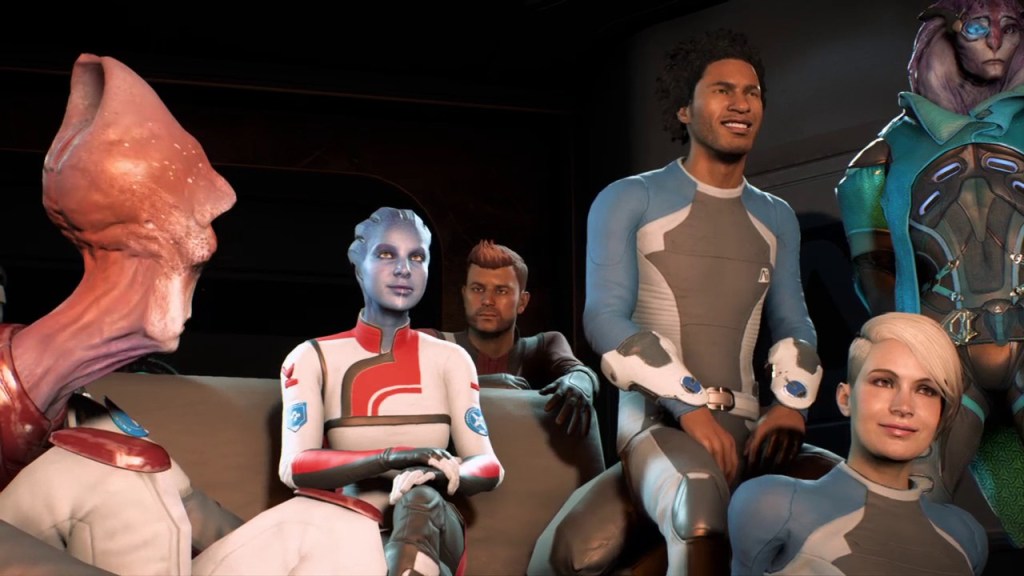
This is a side quest, and I think well worth it if only for the quips and jabs at the movie the crew of the Tempest watches, which reflects real life in the Mass Effect universe. It’s also a chance for the player to interact and see their characters in a new light, which, unfortunately, happens so late in the game.
This quest is a long cut scene with a small part the player can control and occurs after the player sets who they will romance. It’s the entire crew sitting and watching a Turian action film–high explosions, overacted, and logically inconsistent. But that’s not the point. It’s the crew ragging on it that makes this such an endearing scene.
My favourite line occurs after the explosion, and Lexi mentions laments that the script was not included in the blast. I was not enjoying the game up to this point and laughed when she said this, making me wonder if the voice actors felt the same way during the production of Andromeda. That portion aside, the quips and jabs were well written and showed good camaraderie with the characters, revealing omitted or unconceived nuances.
This quest reminded me of the Apartment quest in Mass Effect 3 DLC, where everyone gets together to hang out. Some drinks and dancing are involved, but mostly serious, cute, and hilarious banter comes out.
Liam’s movie night was an enjoyable experience all around. As the player, it let me see another side of the characters that was sorely missed. I’ve added a link to a YouTube video which shows the scene. It’s four minutes long. https://www.youtube.com/watch?v=A5aXpzk9mvk
The rest…
I had planned on writing out more points, but it wasn’t easy to provide any meaning beyond just giving you a detailed list to use up your time. I think they’re important to mention because this game had too many wrong things with it. Discussing what it got right would try and give it balance. I have briefly listed them below:
Final Boss Level – Goosebumps when everyone you helped shows up to help you.
Soundtrack – Amazing for writing!
Don’t talk to people – Remove the option to speak to an NPC once I have talked to them. If there’s nothing more to say, don’t waste my time.
The Initiative – Cool name. This name is an ideal, and I don’t think it’s seen often in science fiction.
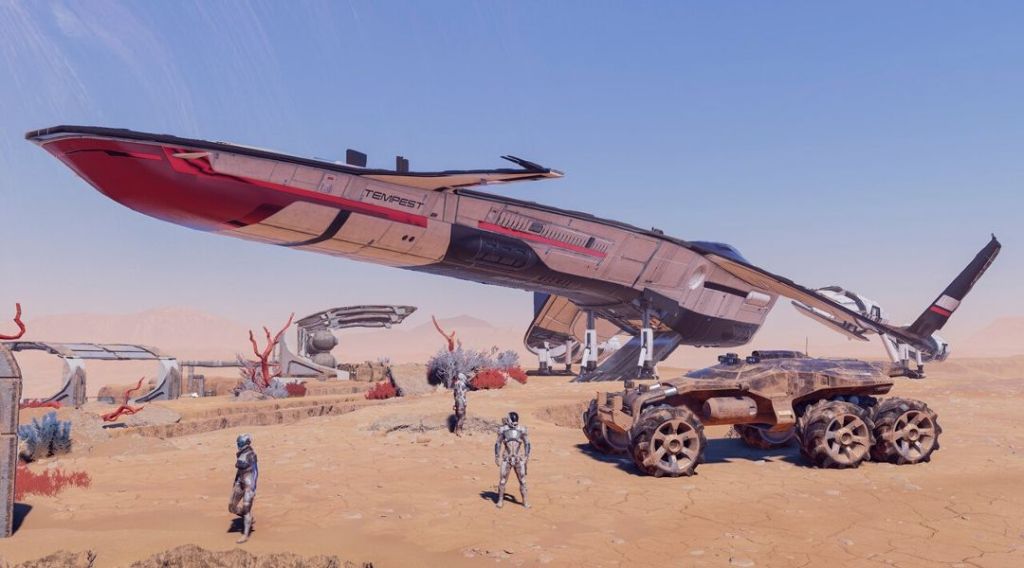
The Tempest – Cool design and small enough not to load scenes.
Purchase High-Level Armour & Weapons – You don’t have to upgrade if you don’t want to. Just purchase them when you level up.
Visuals on everything but the characters – The rendering of everything, celestial objects, ships, plants, etc., were excellent! Not the rendering of characters, though.
Romance with nudity – tasteful and added to the realism without being gratuitous.
 Michael Leask
Leave a comment